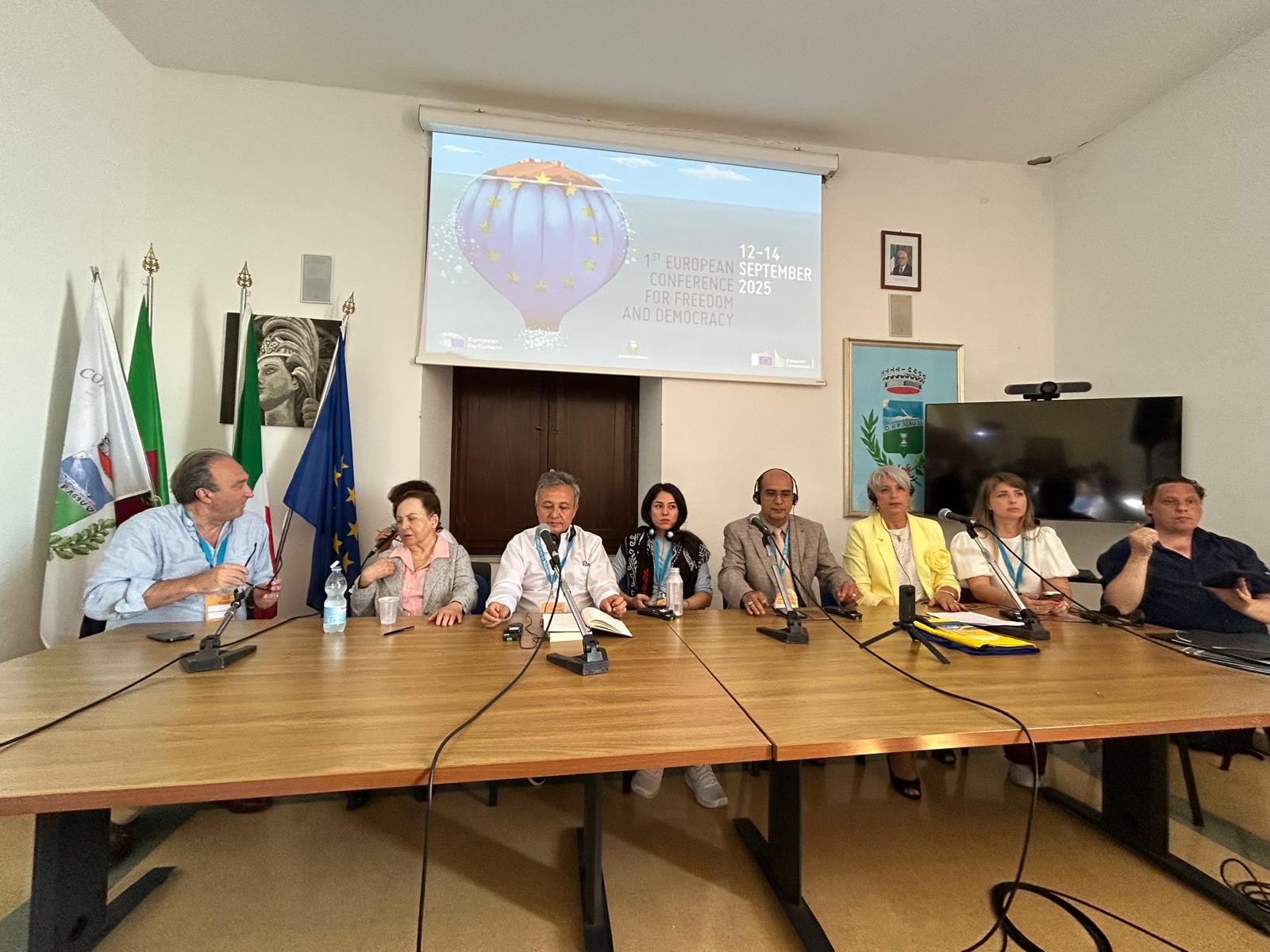
FIRST EUROPEAN FORUM FOR DEMOCRACY
Introduction
At the historic First European Forum for Democracy, held in Ventotene, Italy (12–14 September 2025), the Democratic Solidarity Party of Al-Ahwaz (ADSP) proudly represented the voice of the Ahwazi Arab nation. Among distinguished political and human rights leaders from across Europe and the world, Mr. Wejdan Afrawi, journalist and member of the ADSP Executive Committee, delivered a keynote speech that placed the Ahwazi struggle firmly within the global movement for democracy and justice.
His address exposed the systematic oppression of minorities in Iran, highlighted the specific plight of the Ahwazi Arabs, and presented a clear and democratic vision for the future of Iran based on federalism, diversity, and self-determination. Below is the full text of his speech as delivered:
Speech by Mr. Wejdan Afrawi
Good morning, ladies and gentlemen,
My name is Wejdan Afrawi. I am a member of the Executive Committee of the Democratic Solidarity Party of Al-Ahwaz, a member of UNPO since 2001, representing the Ahwazi-Arab nation.
First, I wish to express my sincere thanks to the Members of the European Parliament, the UNPO, and all organizers of this important and timely event.
It is encouraging to see that some EU members and MEPs are raising their voices against the systematic oppression of minorities in Iran. This discussion is both relevant and urgent.
With just a brief look at the crisis zones in the Middle East, one quickly sees a pattern: disenfranchisement, marginalization, and exclusion of non-dominant nationalities lie at the root of most conflicts. This is true in Syria, Iraq, Lebanon, Yemen, Turkey, Sudan, Israel—and certainly in Iran.
Understanding Iran’s Ethnic Reality
There exists a dangerous misconception—promoted by the Iranian regime and its lobbyists in the West—that Iran is a Persian nation-state. That Iran is Persia.
In truth, Iran is one of the most ethnically diverse countries in the region. It is a multinational state composed of at least six major nationalities: Ahwazi Arabs, Baluchis, Kurds, Persians, Azerbaijani-Turks, and Turkmen, alongside several smaller ethnic, linguistic, and tribal communities. No single group holds a numerical majority.
Religiously, Iran is home to Sunnis, Christians, Jews, Baháʼís, Mandaeans, and others. Together, these ethnic and religious minorities represent at least 50%—and by some estimates, up to two-thirds—of the population.
And yet, they are not accorded equal citizenship. Their languages, cultures, and faiths are not officially recognized.
According to Mr. Hajbabaei, a former Iranian education minister, only 30% of first-grade students speak Farsi as their mother tongue. And yet, Persian is the sole official language. Similarly, while nearly one-third of Iranians are Sunnis, Ja’fari Shia Islam remains the only state-sanctioned religious doctrine.
This system, built on Persian-Shia supremacy, has deliberately privileged one group—ethnic Persian Shias—at the expense of all others. Using language, education, religion, literature, and state institutions, Iran has created a structure of exclusion and inequality that stifles any chance of democratic transformation.
The Case of the Ahwazi Arabs
Nowhere is this injustice more evident than in the case of the Ahwazi Arabs.
Residing primarily in the southwest of Iran, in the province officially known as Khuzestan, or by its indigenous name Eghlim Al-Ahwaz or Arabistan, the Ahwazi Arabs represent an ethnic, linguistic, and national minority.
They face a double oppression: politically marginalized by the regime and racially targeted by extreme Persian nationalism. Many ultra-nationalist Persians claim that Arabs, and specifically the Ahwazi, are to blame for introducing Islam to Persia—thus allegedly causing the collapse of its ancient civilization. This is, of course, a baseless and racist narrative.
While our land accounts for over 90% of Iran’s oil revenue, the Ahwazi Arab population lives in abject poverty, systematically denied access to resources, jobs, education, and political representation.
Ahwazi newborns are not permitted to be given Arab names. The names of cities and towns have been changed to erase their cultural identity. Their protests are violently repressed. Their mother language is not taught in schools. Their youth are imprisoned or executed for demanding rights.
Ahwazi Arabs are estimated to number 8–10 million people, making up around 10% of Iran’s population—and yet they are among the most economically and politically excluded.
A National Awakening and a Federal Future
However, there is hope.
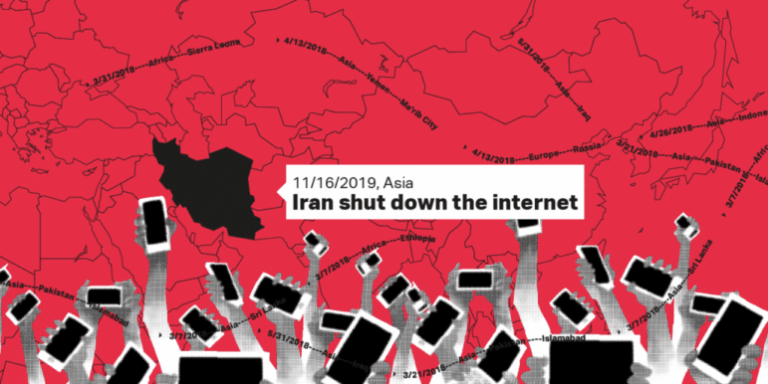
In recent decades, thanks to the rise of information technology and satellite media, a new wave of national awakening and awareness has emerged—not only among Ahwazis but among all non-dominant groups in Iran. More and more people are challenging the regime and calling for its overthrow and a new future.
Our party, the Democratic Solidarity Party of Al-Ahwaz, affirms the right of peoples to self-determination, in accordance with international law:
• The International Covenants on Civil and Political Rights and on Economic, Social and Cultural Rights (1966)
• The UN General Assembly Resolution of 1970
• The Helsinki Final Act (1975)
• The Charter of the OSCE (1994)
We understand self-determination as a spectrum: from autonomy to federation, confederation, and ultimately secession, depending on the will of the peoples.
At this stage, we believe that the most realistic and implementable path forward is the establishment of a democratic federal republic in Iran—with a decentralized central government and devolved powers to the provinces.
This would allow the Ahwazi nation—and other oppressed groups—to:
• Elect their own regional parliament
• Be represented by a regional president or governor
• Protect their cultural and linguistic rights
• Manage their natural resources
• Secure international recognition
Such a federal arrangement would put an end to the cultural genocide, ethnic cleansing, and socio-economic subjugation imposed by the current regime.
Challenging the Myth of Fragmentation
Critics of federalism in Iran—both within the regime and the broader opposition—often cite the fear of national fragmentation, pointing to the Balkans as a warning.
They assume that Iran’s ethnic minorities are inherently disloyal.
But this is not only incorrect—it is deeply racist. It implies that the only way to preserve the Iranian state is through force and repression, not cooperation and mutual respect.
Let us be clear: federalism is not fragmentation. It is unity through diversity. It is the only path to a peaceful, democratic, and inclusive Iran.
Sadly, many Persian-led opposition groups have failed to acknowledge this reality. Their refusal to extend solidarity to oppressed groups like the Ahwazi Arabs is leading many young people into the arms of radical alternatives—a dangerous path that will only deepen the crisis.
Conclusion
The road ahead will not be easy. But with courage, clarity, and commitment, we can work toward a just and democratic Iran—one that embraces all its peoples, not just a privileged few.
We are here today to say: the Ahwazi Arab nation will not be silenced. Our voice, our history, our future matter.
We call upon the international community—and especially the European Parliament—to support our right to dignity, identity, and self-determination.
Thank you.